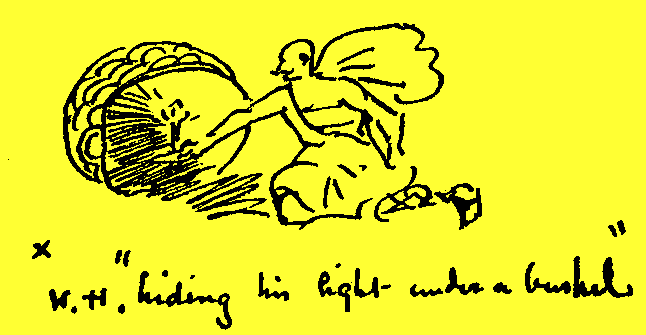
Washington Allston suggested in his "Lectures on Art," artists should use such images in paintings as a device to convey additional ideas and feelings. The effect of such a mechanism may be greater when the viewer is not consciously aware of the cause. Homer's use of Allston's device can be seen throughout his works, beginning with his earliest childhood drawings. The paper Homer's Childhood in Cambridge presents a detailed discussion of Homer's childhood in Cambridge and Allston's probable influence.
An artist who paints the moon might "improve," or idealize, the image of the "man in the moon." Homer idealized images that he painted. This can be seen in examples where a sketch is available to compare with the final work. Especially see the Boat Builders example.
Images shown here as examples are among the easiest to see, which is the first reason they were selected. Seeing the sample images is not enough however, since it is important for viewers to recognize that Homer actually saw and intentionally painted such images. More importantly therefore, the examples shown here were primarily selected because they seem most likely to be recognized as things Homer actually saw and represented, rather than merely projections created by my imagination.
Homer was a realist, but he saw more than just objects physically present. He also saw and painted a personal and obtuse phenomenal reality which is the subject of this web site. The written materials on this site provide extensive background details, in order to help place the private side of "The Obtuse Bard" in context. The paper Fully Understood? presents a discussion of evidence indicating that Homer and his friends felt there was much more to his work than was publically known and appreciated. Since Homer may have realized the effect of these images functioned best subliminally, his fellow artists may have felt bound not to specifically discuss this hidden aspect of his work.
With the visual examples, I have taken a search/answer page approach to give the viewer an opportunity to try to "discover" the sample images before being shown. Discovering the images results in a more direct communication with Winslow Homer and is more effective as visual training. Be warned however: there are seemingly endless images to be discovered within Homer's works. Therefore, do not be surprised to find images in addition to the samples. Also, as you look at one image, you may suddenly see an entirely different overlapping, or switching image. Once you start to see these "hidden" images, you will know that your imagination has begun reading the obtuse visual poetry of Winslow Homer.
Thank you for viewing this site.
Peter Bueschen
Simi Valley, California
************************************************************
| CONTENTS |
|
| Visual evidence |
The papers present background information explaining why Homer painted such images, but please note that I have been guided by what I see in Homer's paintings. I began researching and writing only after I was advised that people would view what I saw as my projections, rather than a reading of Homer's projections, unless I could provide a logical explanation why he might have painted such images. I was astonished when I read Washington Allston, Richard Henry Dana Sr, Benjamin Welles, Henry Wadsworth Longfellow, and William Cullen Bryant. |
| Written evidence |
Written statements by Edwin Austin Abbey and John LaFarge indicate that Homer's work was somehow not fully understood. John Beatty wrote, after a visit with Homer, that Homer felt not understood. Even Homer wrote in a letter to Beatty, "What is the use? The people are too stupid. They do not understand." Winslow Homer grew up in the then small town of Cambridge Massachusetts surrounded by Washington Allston, Richard Henry Dana Sr., Benjamin Welles, William Ellery Channing, Henry Wadsworth Longfellow and Louis Agassiz and their views. |
| |
| Related links |
Through our eyes, what we see and how we are effected is always indirect, processed by our mind, consciously and unconsciously, integrated and filtered with our own unique past experience. Below are some selected links, mostly from non-art sources, that may expand your thinking about visual imagination and human perception. |
|
|
|
|
|
Archives of this site are available on archive.org's WayBackMachine 
|
|